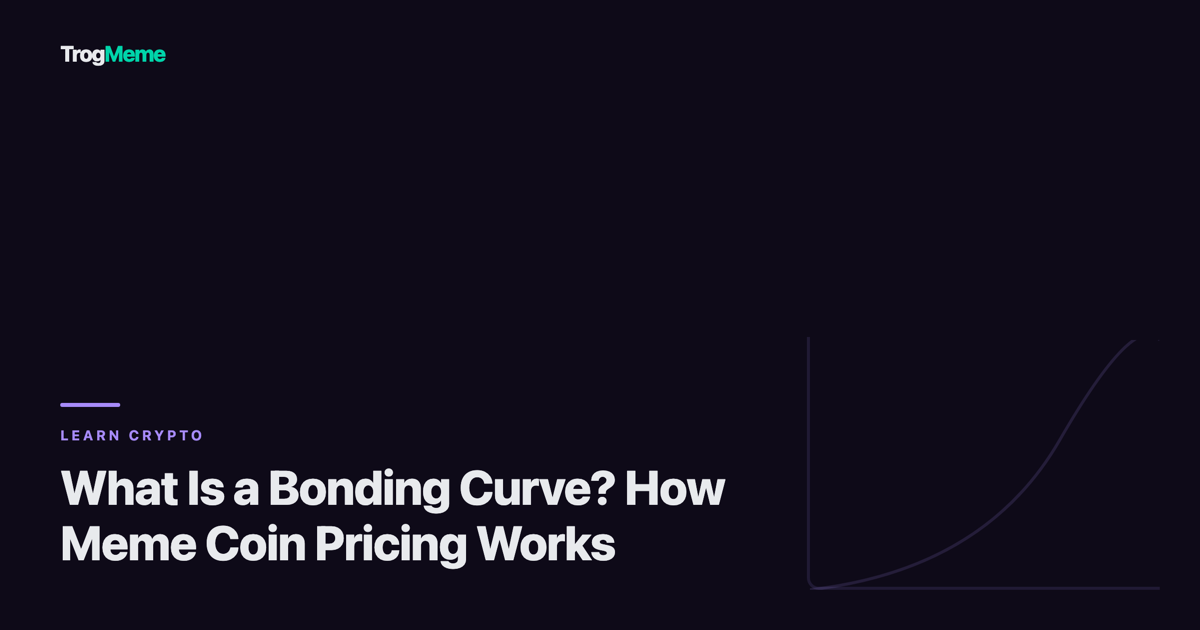
Every meme coin launched on Pump.fun starts with no liquidity pool and no order book. Instead, a bonding curve smart contract acts as the sole market maker. The contract mints tokens when you buy and sets the price algorithmically based on how many tokens have already been sold. This mechanism determines every Pump.fun token’s price from the first fraction of a cent to its graduation at roughly $69,000 market cap.
Understanding bonding curves is essential for anyone participating in the Solana meme coin ecosystem. This guide connects directly to our beginner’s guide to buying meme coins, which covers wallet setup and transaction execution.
What Is a Bonding Curve in Simple Terms?
Think of a bonding curve like a vending machine with dynamic pricing. The first candy bar costs $0.01. The second costs $0.02. The hundredth costs $1.00. The more candy bars sold, the higher the price for the next one. If someone returns a candy bar, the price drops back down.
This concept was formalized in a 2017 paper by Simon de la Rouviere and implemented in early Ethereum projects. Ethereum’s developer documentation references bonding curves as a token distribution primitive. The mathematical relationship between supply and price can take different shapes: linear, exponential, logarithmic, or sigmoid. Each shape produces different economic incentives.
Pump.fun uses an exponential-style bonding curve for its Solana meme coin launches. The curve is steep: early buyers get tokens at fractions of a cent, while later buyers pay orders of magnitude more for the same number of tokens. This structure rewards early discovery and punishes late entry. It is the defining economic mechanic of the Pump.fun meta.
How Does Pump.fun Use Bonding Curves to Price New Meme Coins?
The Pump.fun bonding curve operates as follows. A token creator launches a coin with zero SOL in the contract. The initial price is extremely low, often below $0.000001 per token. As buyers deposit SOL, the contract mints and distributes tokens while simultaneously increasing the price for the next buyer. Pump.fun’s interface displays a progress bar showing how much of the bonding curve has been filled.
The total bonding curve capacity is approximately 85 SOL (the exact amount fluctuates slightly with Pump.fun’s fee structure). At this threshold, the bonding curve is considered complete. The token has reached a market cap of roughly $69,000. At completion, the contract stops accepting new purchases through the bonding curve and the token graduates to a Raydium liquidity pool.
During the bonding curve phase, Pump.fun charges a 1% fee on each transaction. There is no traditional liquidity pool. The bonding curve contract itself acts as the sole buyer and seller. This means there is always liquidity: you can sell tokens back to the curve at the current price. However, selling drops the price for all remaining holders. Solana’s documentation on program-derived accounts explains the technical infrastructure underlying these contracts.
What Happens When a Pump.fun Token Graduates to Raydium?
The graduation process is automated and irreversible. When the bonding curve reaches its SOL threshold, Pump.fun’s smart contract executes several operations in sequence. It removes all SOL from the bonding curve. It pairs that SOL with the remaining unallocated tokens. It creates a new trading pair on Raydium, Solana’s largest AMM. It deposits both assets as initial liquidity. It burns the LP tokens by sending them to a dead address.
| Bonding Curve Stage | Approximate Price Range | Market Cap Range | Supply Sold | Risk Level |
|---|---|---|---|---|
| 0-20% filled | $0.000001 – $0.000005 | $0 – $4,000 | ~160M tokens | Highest (most tokens fail here) |
| 20-50% filled | $0.000005 – $0.00003 | $4,000 – $20,000 | ~400M tokens | High (gaining traction) |
| 50-80% filled | $0.00003 – $0.00007 | $20,000 – $50,000 | ~640M tokens | Medium (likely to graduate) |
| 80-100% filled | $0.00007 – $0.00009 | $50,000 – $69,000 | ~800M tokens | Lower (graduation imminent) |
| Post-graduation (Raydium) | Market-determined | $69,000+ | Market supply | Standard DEX trading risk |
LP token burning is critical. It means no one, including Pump.fun and the token creator, can remove the initial liquidity from Raydium. This provides a permanent floor of tradeable liquidity. It is the primary reason Pump.fun graduated tokens are considered safer than tokens launched directly on Raydium with unlocked LP tokens.
Dune Analytics dashboards tracking Pump.fun show that fewer than 2% of tokens created on the platform reach graduation. The vast majority die on the bonding curve with less than 10% filled. Graduation itself does not guarantee price appreciation. Many tokens dump immediately after graduating as bonding curve buyers take profits on Raydium. Check the Pump.fun tutorial for step-by-step buying instructions.
How Does the Bonding Curve Formula Determine Each Buy Price?
The simplified relationship works like this. If the first 1 SOL deposited buys 10 million tokens, the second SOL might buy 8 million tokens, and the tenth SOL buys only 2 million tokens. The exact shape of Pump.fun’s curve is proprietary, but on-chain analysis by Dune Analytics researchers has reverse-engineered the approximate function from transaction data.
What this means in practice: a buyer who enters at 10% bonding curve completion pays roughly 5-10x less per token than a buyer entering at 80% completion. This is not a small difference. On a token that graduates and then does a 10x on Raydium, the early buyer might see a 100x total return while the late bonding curve buyer sees a 10x. The curve mathematically front-loads returns to early participants.
This structure creates an explicit incentive hierarchy: creators who launch and immediately buy their own token get the best price, followed by early snipers using bots, followed by manual buyers who discover the token organically. Understanding this hierarchy is essential. You are always buying at a higher price than someone who came before you. The question is whether enough buyers will come after you to push the price higher.
Why Do Early Buyers on Bonding Curves Get Dramatically Better Prices?
My opinion: the bonding curve mechanic on Pump.fun is the most honest pricing mechanism in the meme coin market. It does not pretend that all buyers get a fair price. The math is transparent: early equals cheap, late equals expensive. This is more honest than a traditional token launch where insiders get a private allocation at a discount while retail buys the public listing at a markup. On Pump.fun, the advantage goes to whoever shows up first, not whoever knows the team.
That said, the advantage of early buying is partially offset by the risk of total loss. Ninety-eight percent of Pump.fun tokens never graduate. Buying early means buying tokens that will almost certainly go to zero. The expected value calculation requires hitting enough graduating tokens to offset the losses on the 98% that fail. CoinGecko’s Solana meme coin tracking confirms that the median Pump.fun token trades for less than 48 hours before volume drops to zero.
The bonding curve also creates a natural sell pressure dynamic at graduation. Early buyers who are sitting on 10-50x gains have a strong incentive to sell immediately when the token hits Raydium and fresh liquidity enters. This is why many tokens dump 30-60% within minutes of graduation. Understanding this pattern is critical for timing both entries and exits. Use the strategies from our guide on buying meme coins on Solana to navigate the graduation transition.
Frequently Asked Questions
Can the token creator rug pull during the bonding curve phase?
The Pump.fun bonding curve contract controls all funds. The token creator cannot withdraw SOL from the curve or mint additional tokens outside the curve’s supply. The primary creator risk is that they pre-buy a large percentage of the curve cheaply and dump on later buyers. This is not a rug pull in the technical sense, but the economic effect is similar.
What happens to my tokens if the bonding curve never fills?
You can always sell tokens back to the bonding curve contract at the current curve price. If the curve never fills, your tokens remain tradeable through the curve. However, if all other buyers sell first, the price will drop back toward the initial value, and you will realize a significant loss.
How much SOL do I need to buy tokens on Pump.fun?
There is no minimum purchase amount. You can buy with as little as 0.01 SOL. However, Solana network fees (approximately 0.000005 SOL per transaction) and Pump.fun’s 1% fee apply. Most active Pump.fun traders operate with 1-10 SOL per trade to make the risk-reward meaningful.
Is the Pump.fun bonding curve the same as other bonding curve platforms?
No. Each platform implements its own curve shape, supply parameters, and graduation mechanics. Pump.fun’s curve and 85 SOL graduation threshold are specific to its contracts. Competitors like Moonshot and Sun Pump use different formulas. The core concept is identical, but the specific pricing mechanics differ.
Why do most Pump.fun tokens fail before graduating?
Graduation requires approximately 85 SOL of total purchases. Most tokens never generate enough buyer interest to reach that threshold. Without a compelling meme, community, or narrative, buying momentum stalls. Early buyers sell back to the curve, dropping the price and discouraging new entries. The token enters a death spiral and is abandoned.